1. Introduction to UPSC Exam 2026
Welcome to the definitive guide for the UPSC Civil Services Examination 2026. If you are reading this, you have likely taken the first step towards one of the most challenging yet rewarding journeys in India. The dream of becoming an IAS, IPS, or IFS officer is shared by millions, but only a few thousand possess the grit, strategy, and perseverance to realize it.
This blog is designed to be your comprehensive companion for the 2026 attempt. Whether you are a complete beginner confused about where to start, or a repeater looking to refine your strategy, this guide covers everything from the basic definition of UPSC to advanced answer-writing techniques.
What is the Union Public Service Commission (UPSC)?
The Union Public Service Commission (UPSC) is India's premier central recruiting agency. It is a constitutional body established under Article 315 of the Constitution of India. While UPSC conducts various examinations for appointment to the services of the Union, its most prominent and widely known function is conducting the Civil Services Examination (CSE) annually.
The UPSC acts as the gatekeeper, selecting the finest minds to run the administrative machinery of the country. It operates with high integrity and autonomy, ensuring a merit-based selection process free from political influence.
Why is the UPSC Exam Considered the Toughest Exam in India?
The "toughest exam" tag is not merely hype; it is backed by statistics and the sheer nature of the examination process. Here is why:
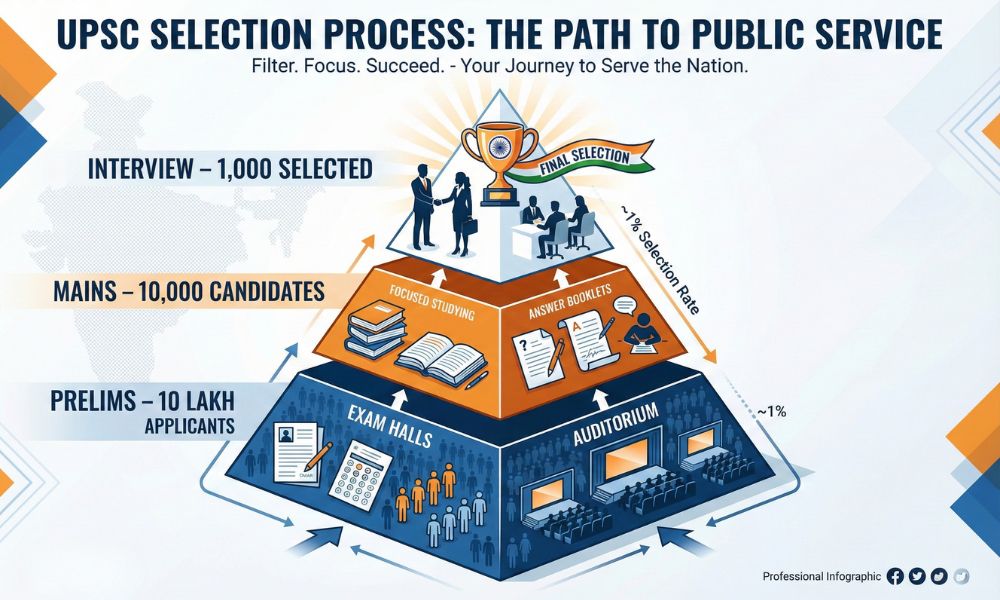
- Staggering Competition: Every year, approximately 10 to 11 lakh aspirants apply for the exam. About 5 to 6 lakh actually appear for the Preliminary stage. Out of these, only around 1,000 candidates finally make it to the merit list. The success rate hovers around an intimidating 0.1% to 0.2%.
- Vast and Diverse Syllabus: The syllabus is often described as "anything under the sun." An aspirant must possess in-depth knowledge of history, geography, polity, economy, environment, science and technology, international relations, and current ethics, alongside a specialized optional subject.
- Grueling Three-Stage Process: The exam spans nearly an entire year. It tests different facets of a candidate's personality: analytical ability in Prelims, depth of knowledge and articulation in Mains, and personality and temperament in the Interview. Failing at any stage means starting right back at square one the next year.
- Mental Resilience: More than academic brilliance, UPSC tests emotional intelligence, patience, and the ability to handle pressure over a sustained period.
Importance of UPSC Exam 2026 for Aspirants
Targeting the UPSC Exam 2026 is a strategic decision. If you are reading this in 2024 or early 2025, you have the most crucial asset required for this exam: Time. The 2026 attempt is ideal for college students currently in their pre-final years, working professionals who need a longer runway to balance work and study, and repeaters who need to completely overhaul their foundation.
UPSC 2026 offers you a window of approximately 18-24 months. This is the "golden period" necessary to build a foundation strong enough to withstand the pressures of the exam cycle.
What You Will Learn in This Ultimate Guide (A-Z Overview)
This blog post is structured to take you from novice to expert regarding the UPSC ecosystem. By the end of this massive guide, you will have clarity on:
- The structure, eligibility, and timeline of the exam.
- The detailed nuances of the different services (IAS vs. IPS vs. IRS).
- A microscopic breakdown of the UPSC Syllabus for Prelims and Mains.
- How to choose the perfect optional subject for you.
- A month-by-month integrated preparation strategy for 2026.
- The definitive booklist and current affairs sources.
- The art of answer writing and mastering mock tests.
- Maintaining mental health and motivation during the long haul.
2. UPSC Civil Services Examination Overview
What is the Civil Services Examination (CSE)?
The Civil Services Examination (CSE) is a nationwide competitive examination conducted by the UPSC (Official Website) for recruitment to various Civil Services of the Government of India. These include the All India Services (Indian Administrative Service and Indian Police Service) and various Central Services (Group A and Group B).
It is not just a job exam; it is a selection process for the future leaders and policy implementers of the nation.
History and Role of UPSC in India
The concept of a merit-based civil service in India dates back to the British East India Company era. The modern UPSC, as we know it, found its roots in the Government of India Act, 1935, and was firmly established by the Constitution of independent India in 1950.
The role of the UPSC is to ensure that the administrative framework of India is run by individuals selected purely on merit, irrespective of their caste, creed, religion, or economic background. It is often called the "Steel Frame of India," a term coined by Sardar Vallabhbhai Patel, emphasizing its role in maintaining the unity and continuity of administration in a diverse nation.
How UPSC Officers Contribute to Nation-Building
Passing the exam is just the beginning. The actual contribution starts in the field. A civil servant wears many hats:
- Policy Implementation: They are the hands and feet of the government, translating laws passed by Parliament into ground-level reality, ensuring schemes reach the intended beneficiaries, from farmers to students.
- Crisis Management: Be it natural disasters like floods and cyclones, pandemics like COVID-19, or law and order situations, civil servants are at the forefront of managing crises and coordinating relief efforts.
- Developmental Agents: Collectors and District Magistrates act as catalysts for development in their districts, overseeing infrastructure projects, healthcare improvements, and educational reforms.
- Policy Formulation: At senior levels in the central secretariat, experienced officers assist ministers in drafting policies that shape the nation's future in sectors like finance, defense, and foreign affairs.
The Annual Exam Cycle and Stages
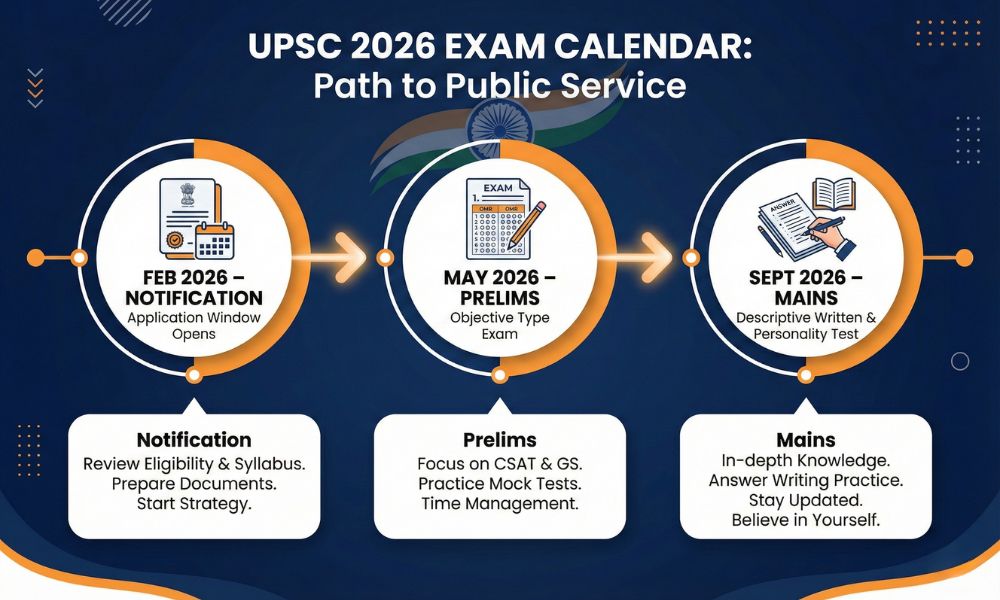
The UPSC CSE is a marathon, not a sprint, spanning roughly 12 months from the first stage to the final result.
- Stage 1: Preliminary Examination (Prelims): Usually held in May/June. It is an objective type (MCQ) screening test. Its marks are not counted for the final ranking, but clearing it is mandatory to reach the next stage.
- Stage 2: Main Examination (Mains): Usually held in September. This is a subjective, written examination consisting of 9 papers. The marks obtained here form the primary basis for final selection.
- Stage 3: Personality Test (Interview): Usually held from February to April of the following year. It assesses the candidate's suitability for a career in public service.
3. Services Offered Through UPSC CSE
While most aspirants aim for the coveted IAS, the CSE is a gateway to about 24 different prestigious services. Your rank and service preference determine which service you are allocated.
Indian Administrative Service (IAS)
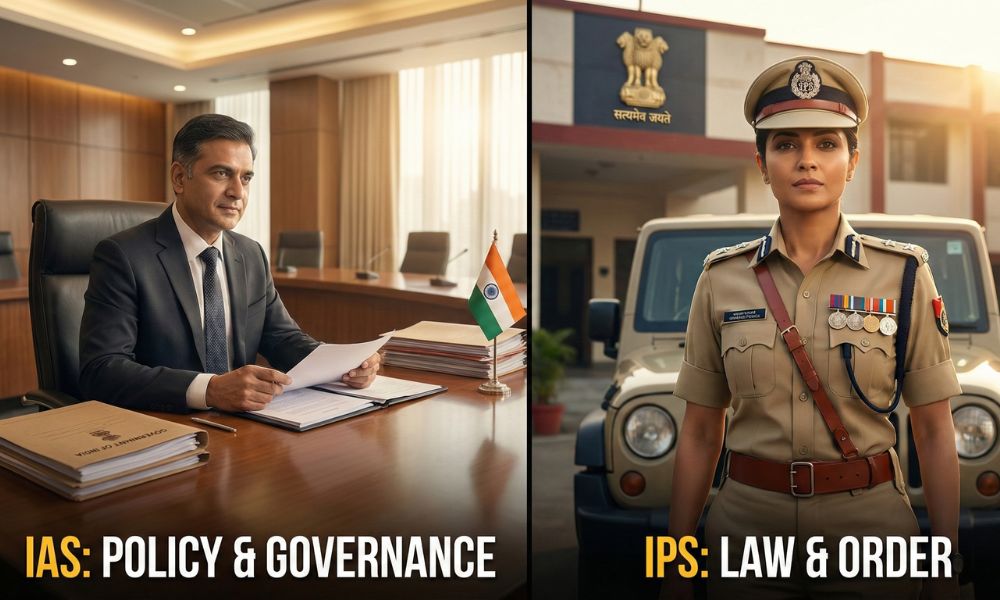
The most sought-after service. An IAS officer is responsible for the administration of the district (as District Magistrate/Collector) and later holds key positions in state and central government ministries. They handle revenue collection, maintain law and order (in coordination with police), and oversee developmental works. They are the generalist administrators of the country.
Indian Police Service (IPS)
The premier uniformed service in the country. IPS officers are responsible for maintaining public order, preventing and detecting crime, and managing traffic. They lead the state police forces and also serve in central agencies like the CBI, IB, and RAW. It is a service demanding physical fitness, courage, and quick decision-making.
Indian Foreign Service (IFS)
IFS officers represent India on the global stage. They are diplomats who manage India's external affairs, including political, economic, and cultural relations with other countries. They work in Indian embassies and high commissions globally and in the Ministry of External Affairs back home.
Indian Revenue Service (IRS) - IT & Customs
There are two branches: IRS (Income Tax) and IRS (Customs and Indirect Taxes). These officers are the financial backbone of the government. They are responsible for tax collection, curbing black money, and formulating tax policies.
Other Group A & Group B Services
Besides the top four, there are numerous other vital services, including:
- Indian Audit and Accounts Service (IA&AS)
- Indian Railway Traffic Service (IRTS)
- Indian Postal Service
- Indian Defence Estates Service
- Indian Information Service (IIS)
- Group B services like DANICS (Delhi, Andaman and Nicobar Islands Civil Service) and DANIPS (Police Service).
Salary, Allowances, and Perks (Overview)
While the primary motivation for civil services is public service and prestige, the compensation is respectable and secure. The starting basic pay is based on the 7th Pay Commission (Level 10 in Pay Matrix), starting around ?56,100 per month, plus allowances like Dearness Allowance (DA), House Rent Allowance (HRA), and Transport Allowance (TA). The gross starting salary is usually over ?80,000 - ?1,00,000+ depending on the posting location.
Crucial Perks: The real value lies in the perks: government accommodation in prime localities, official vehicles, medical facilities for self and family, security guards (for specific posts), study leaves, and a secure pension post-retirement.
4. UPSC Exam 2026 Important Dates (Expected)
Note: The official UPSC calendar for 2026 will be released by the UPSC around mid-2025. The dates below are highly probable estimations based on decades of consistent UPSC trends. Aspirants must use these for planning but rely only on the official notification once released.
| Event | Expected Timeline for 2026 |
|---|---|
| UPSC CSE 2026 Official Notification Release | February 2026 (Usually first or second week) |
| Application Start Date | Same day as notification release |
| Application Last Date | Early March 2026 (Usually 20-25 days after release) |
| UPSC Prelims Exam Date 2026 | Late May 2026 or Early June 2026 (Most critical date for planning) |
| Prelims Result Declaration | June/July 2026 (Within 30-45 days of Prelims) |
| Detailed Application Form (DAF-I) for Mains | July/August 2026 |
| UPSC Mains Exam Date 2026 | Mid-September 2026 (Usually spans over 5-7 days) |
| Mains Result Declaration | December 2026 |
| DAF-II (For Interview) | December 2026 / January 2027 |
| Interview / Personality Test | February 2027 to April 2027 |
| Final Result Declaration | April / May 2027 |
Want to check the previous trends of papers?
Download UPSC Previous Year Question Papers Here5. Eligibility Criteria for UPSC Exam 2026
Before diving into preparation, you must ensure you are eligible. The criteria are strictly enforced. For a detailed breakdown, you can check our dedicated guide on IAS Eligibility and Pattern.
5.1 Nationality Criteria
- For IAS and IPS: The candidate MUST be a citizen of India.
- For other services: A candidate must be either:
- A citizen of India, or
- A subject of Nepal/Bhutan, or
- A Tibetan refugee who came to India before 1st January 1962 with the intention of permanently settling in India, or
- A person of Indian origin who has migrated from selected countries (like Pakistan, Burma, Sri Lanka, East African countries) with the intention of permanently settling in India.
5.2 Age Limit for UPSC 2026
Age is often a major concern. The UPSC has strict minimum and maximum age limits based on category.
Crucial Reference Date: The age is usually calculated as of 1st August of the exam year. For UPSC 2026, you must meet the age criteria as of 1st August 2026.
| Category | Minimum Age (as of Aug 1, 2026) | Maximum Age (as of Aug 1, 2026) |
|---|---|---|
| General / EWS (Economically Weaker Section) | 21 Years | 32 Years |
| OBC (Other Backward Classes - Non-Creamy Layer) | 21 Years | 35 Years (32 + 3 years relaxation) |
| SC / ST (Scheduled Caste / Tribe) | 21 Years | 37 Years (32 + 5 years relaxation) |
| PwBD (Persons with Benchmark Disability) | 21 Years | 42 Years (General/EWS/OBC), 47 Years (SC/ST) |
| Defence Services Personnel (disabled in operations) | 21 Years | 35 Years (Up to 40 for SC/ST) |
5.3 Educational Qualification
The academic requirement is straightforward:
- Minimum Requirement: The candidate must hold a degree (Graduation in any stream Arts, Science, Commerce, Engineering, Medicine, etc.) from any of the Universities incorporated by an Act of the Central or State Legislature in India, or other educational institutions established by an Act of Parliament or declared to be deemed as a University under Section 3 of the UGC Act, 1956.
- Can Final Year Students Apply for UPSC 2026?
YES. Candidates who have appeared for their qualifying examination (final year/semester) and are awaiting results can apply for the Preliminary Examination. However, they must produce proof of passing the requisite qualification before applying for the Main Examination (usually in July/August 2026). - Distance Education: Degrees obtained through open universities or distance education modes (like IGNOU) are fully recognized and accepted by UPSC, provided the university is recognized by the UGC/AICTE.
5.4 Number of Attempts
UPSC restricts the number of times you can appear for the exam. An attempt is counted only if you appear in at least one paper of the Preliminary Examination. Applying but not showing up for the exam is NOT counted as an attempt.
| Category | Maximum Number of Attempts |
|---|---|
| General / EWS | 06 Attempts |
| OBC (Non-Creamy Layer) | 09 Attempts |
| SC / ST | Unlimited Attempts (till upper age limit is reached) |
| PwBD (General/EWS/OBC) | 09 Attempts |
| PwBD (SC/ST) | Unlimited Attempts |
Strategy Note for 2026 Aspirants on Attempts: If you are a General/EWS category candidate, 6 attempts might seem like a lot, but they run out fast. Do not give the 2026 attempt as a "trial" run unless your preparation is solid. A half-hearted attempt is a wasted attempt. Use the time until 2026 to ensure your first attempt is your best attempt.
6. UPSC Exam Pattern 2026 (Detailed)
Understanding the battlefield is the first step to winning the war. The UPSC exam pattern is designed to test depth, breadth, and consistency.
6.1 UPSC Preliminary Examination Pattern (The Filtering Stage)
The Prelims is purely a screening test. It consists of two objective-type (Multiple Choice Questions) papers held on a single day.
| Paper | Subject | Total Marks | Duration | Nature |
|---|---|---|---|---|
| Paper I | General Studies (GS) | 200 (100 Qs x 2 marks) | 2 Hours | Merit Counting (Cut-off is based on this) |
| Paper II | CSAT (Civil Services Aptitude Test) | 200 (80 Qs x 2.5 marks) | 2 Hours | Qualifying (Need 33% i.e., 66+ marks) |
?? The Negative Marking Trap
Both papers in Prelims have negative marking. For every incorrect answer, one-third (0.33) of the marks assigned to that question are deducted. This means in Paper I, -0.66 marks for a wrong answer, and in Paper II, -0.83 marks.
6.2 UPSC Mains Examination Pattern (The Selection Stage)
This is the core of the examination. It consists of 9 papers, out of which 2 are qualifying and 7 are counted for merit. All papers are descriptive (subjective) in nature.
Part A: Qualifying Papers (Marks NOT counted for rank)
- Paper A: One Indian Language (from 8th Schedule of Constitution) - 300 Marks.
- Paper B: English Language - 300 Marks.
- Note: You must score minimum 25% in these to have your other papers evaluated.
Part B: Merit Papers (Marks Counted for Rank)
| Paper No. | Subject | Marks |
|---|---|---|
| Paper I | Essay | 250 |
| Paper II | General Studies I (History, Geography, Society) | 250 |
| Paper III | General Studies II (Polity, Governance, IR) | 250 |
| Paper IV | General Studies III (Economy, Tech, Environment) | 250 |
| Paper V | General Studies IV (Ethics, Integrity, Aptitude) | 250 |
| Paper VI | Optional Subject Paper 1 | 250 |
| Paper VII | Optional Subject Paper 2 | 250 |
| Total | Mains Written Total | 1750 |
6.3 UPSC Interview / Personality Test
Candidates who clear the Mains cut-off are called for the interview in Delhi.
- Total Marks: 275
- Grand Total (Mains + Interview): 2025 Marks
What UPSC Evaluates: It is not a test of knowledge (that was Mains). It is a test of your personality. The board assesses intellectual curiosity, critical powers of assimilation, balance of judgement, variety and depth of interest, ability for social cohesion, mental alertness, and moral integrity.
7. UPSC Syllabus 2026 Complete Breakdown
The syllabus is your bible. Memorize it. Every topic mentioned below must be prepared thoroughly. You can download the full UPSC Syllabus PDF here.
7.1 UPSC Prelims Syllabus
Paper I (General Studies):
- Current events of national and international importance.
- History of India and Indian National Movement.
- Indian and World Geography Physical, Social, Economic geography of India and the World.
- Indian Polity and Governance Constitution, Political System, Panchayati Raj, Public Policy, Rights Issues, etc.
- Economic and Social Development - Sustainable Development, Poverty, Inclusion, Demographics, Social Sector Initiatives, etc.
- General issues on Environmental ecology, Bio-diversity and Climate Change (that do not require subject specialization).
- General Science.
Paper II (CSAT):
- Comprehension.
- Interpersonal skills including communication skills.
- Logical reasoning and analytical ability.
- Decision making and problem solving.
- General mental ability.
- Basic numeracy (numbers and their relations, orders of magnitude, etc.) Class X level.
- Data interpretation (charts, graphs, tables, data sufficiency etc.) Class X level.
7.2 UPSC Mains Syllabus (GS I IV)
GS Paper I: Indian Heritage and Culture, History and Geography of the World and Society
- Culture: Art forms, literature, and architecture from ancient to modern times.
- Modern History: Mid-18th century to present (personalities, issues, Freedom Struggle).
- World History: Industrial revolution, World wars, Redrawing of national boundaries, Colonization, Decolonization, Political philosophies (communism, capitalism, socialism).
- Society: Role of women, Population issues, Poverty, Urbanization, Globalization, Social empowerment, Communalism, Regionalism, Secularism.
- Geography: Physical geography, Distribution of key natural resources (world & India), Factors responsible for location of industries, Earthquakes, Tsunami, Volcanic activity, Cyclone.
GS Paper II: Governance, Constitution, Polity, Social Justice and International Relations
- Polity: Indian Constitution (features, amendments, basic structure), Functions of Union and States, Separation of powers, Parliament and State legislatures, Judiciary, Representation of People's Act.
- Governance: Constitutional bodies, Statutory/Regulatory/Quasi-judicial bodies, Government policies for development, NGOs, SHGs, E-governance, Citizen's Charters, Transparency & Accountability.
- Social Justice: Welfare schemes for vulnerable sections, Health, Education, Human Resources issues.
- IR: India and its neighborhood, Bilateral/Regional/Global groupings (Quad, BRICS, etc.) involving India, Effect of policies of developed countries on India's interests, Diaspora.
GS Paper III: Technology, Economic Development, Bio-diversity, Environment, Security and Disaster Management
- Economy: Indian Economy, Planning, Mobilization of resources, Inclusive growth, Government Budgeting, Major crops, Irrigation, Storage, Transport, Food processing, Land reforms, Liberalization, Infrastructure, Investment models.
- Science & Tech: Developments in everyday life, Indigenization of technology, IT, Space, Computers, Robotics, Nanotech, Biotech, IPR issues.
- Environment: Conservation, Environmental pollution and degradation, Environmental impact assessment.
- Security: Disaster Management, Extremism (Naxalism), Internal security challenges, Cyber security, Money laundering, Border management, Organized crime and terrorism.
GS Paper IV: Ethics, Integrity and Aptitude
- Theory: Ethics and Human Interface, Human Values, Lessons from great leaders/reformers.
- Attitude: Content, structure, function; influence on thought and behavior; political and moral attitude.
- Aptitude: Integrity, impartiality, non-partisanship, objectivity, empathy, tolerance for weaker sections.
- Emotional Intelligence: Concepts and application in administration.
- Probity in Governance: Concept of public service, RTI, Code of Conduct, Citizen's Charters, Corruption.
- Case Studies: Practical application of the above topics.
7.3 Essay Syllabus
Unlike GS papers, there is no defined syllabus for the Essay. You are required to write two essays (125 marks each) from two distinct sections. Topics generally range from:
- Philosophical/Abstract: e.g., "Simplicity is the ultimate sophistication."
- Social/Economic/Political Issues: e.g., "Health and Education are the twin pillars of development."
The key here is coherence, structure, flow of thought, and the ability to connect multiple dimensions (social, political, economic, historical) into a single narrative.
8. Optional Subjects in UPSC Exam 2026
The optional subject is the game-changer. It carries 500 marks (250 x 2 papers). A high score in the optional (300+) can ensure a top 100 rank, while a low score can push you out of the list entirely.
List of Popular Optional Subjects
UPSC allows you to choose from a wide range of subjects. Some of the most popular ones include:
- Social Sciences: Sociology, Geography, Political Science & International Relations (PSIR), Public Administration, History, Anthropology, Psychology, Philosophy.
- Literature: Hindi Lit, English Lit, Maithili, Malayalam, Tamil, Kannada, etc.
- Technical/Science: Mathematics, Physics, Chemistry, Botany, Zoology, Agriculture, Medical Science, Engineering (Civil, Mechanical, Electrical).
- Commerce/Professional: Commerce & Accountancy, Law, Management, Economics.
Criteria to Choose the Right Optional for 2026
Do not choose an optional just because the previous year's topper chose it. Choose based on these three factors:
- Interest: You will have to study this subject at a Master's level depth. If you find it boring, you will not be able to sustain the momentum.
- Overlap with GS: Subjects like PSIR, Public Administration, Geography, and History overlap significantly with General Studies papers. This reduces your overall study load.
- Availability of Guidance/Material: Ensure that books, notes, and test series are easily available for your chosen subject.
Science vs Arts Optional: The Dilemma
Science/Engineering Subjects (Maths, Physics):
Pros: High scoring potential (you can get 350+ if correct). Objective marking.
Cons: Syllabus is vast. If you get a question wrong, you get zero. No overlap with GS.
Humanities Subjects (Sociology, PSIR, Anthro):
Pros: Syllabus is manageable. Helps in GS and Essay. Subjective marking (safe scores).
Cons: Hard to score exceptionally high (320+ is rare). Average scores are common.
Popular Trend: For UPSC 2026, Anthropology and PSIR are expected to remain top favorites due to their concise syllabus and high success rate in recent years.
9. UPSC Exam 2026 Preparation Strategy (Step-by-Step)
Success in UPSC is 20% knowledge and 80% strategy. Without a roadmap, you are just wandering. Here is how you should structure your path to 2026.

9.1 When to Start Preparation for UPSC 2026?
For the 2026 attempt, the timeline is your biggest advantage.
- The Ideal Start: Start by June 2024 to January 2025. This gives you a solid 18,24 months.
- For Freshers (College Students): Use your semester breaks to complete NCERTs. Dedicate the last 12 months (starting May 2025) entirely to the core syllabus.
- For Working Professionals: You need a longer runway because you have fewer hours per day. Start immediately. 24 months of 4 hours/day is better than 12 months of 10 hours/day for you.
9.2 Integrated Strategy (Prelims + Mains)
A common mistake beginners make is treating Prelims and Mains as separate exams. They are not. They are different stages of the same exam testing the same knowledge base.
The Golden Rule: "Prepare for Mains, and Prelims will take care of itself."
- Phase 1 (Foundation): Focus on understanding concepts (NCERTs). Do not worry about multiple-choice questions yet.
- Phase 2 (Mains Specific): Complete your Optional Subject and Ethics paper first. These are high-scoring areas that you cannot touch once the Prelims pressure starts.
- Phase 3 (Prelims Exclusive): 3 to 4 months before the Prelims 2026 exam (i.e., from Feb 2026), stop all Mains preparation. Focus only on MCQs, facts, and revision.
9.3 Daily Study Plan for UPSC 2026
Consistency beats intensity. Here is a realistic schedule for a full-time aspirant targeting 2026.
| Time Slot | Activity | Purpose |
|---|---|---|
| 6:00 AM - 8:00 AM | GS Core Subject (e.g., Polity/History) | Fresh mind for heavy concepts. |
| 8:00 AM - 9:00 AM | Breakfast & Break | Recharge. |
| 9:00 AM - 11:00 AM | Newspaper (The Hindu/Indian Express) | Current Affairs + Note making. |
| 11:00 AM - 1:00 PM | Optional Subject | Critical for Mains rank. |
| 1:00 PM - 3:00 PM | Lunch & Nap | Rest is essential for memory retention. |
| 3:00 PM - 5:00 PM | Optional Subject (Contd.) or CSAT | Deep dive into specialization. |
| 5:00 PM - 6:00 PM | Evening Walk / Exercise | Physical health = Mental health. |
| 6:00 PM - 8:00 PM | Revision / Answer Writing | Review what you studied yesterday. |
10. UPSC Books List for 2026 Preparation
There are thousands of books, but you only need a few. Limit your resources and multiply your revision.
10.1 NCERT Books Importance
NCERTs are the foundation. Skipping them is like building a skyscraper without a base. Read History, Geography, Economy, and Polity NCERTs from Class 6 to 12 (or 9 to 12 depending on your background). Read them at least twice before touching standard books.
10.2 The Holy Grail: Standard Reference Books
These books are non-negotiable for every aspirant.
| Subject | Book Name | Author/Publisher |
|---|---|---|
| Polity | Indian Polity | M. Laxmikanth |
| Modern History | A Brief History of Modern India | Spectrum (Rajiv Ahir) |
| Ancient/Med. History | Tamil Nadu Board History Books (Class 11 & 12) | TN State Board |
| Art & Culture | Indian Art and Culture | Nitin Singhania |
| Geography | Certificate Physical and Human Geography | G.C. Leong |
| Economy | Indian Economy | Nitin Singhania OR Ramesh Singh |
| Environment | Environment | Shankar IAS Academy |
| Ethics | Lexicon for Ethics, Integrity & Aptitude | Chronicle |
10.3 Current Affairs Sources
- Primary Source: One National Newspaper daily (The Hindu OR The Indian Express). Do not read both; it wastes time.
- Secondary Source: One Monthly Compilation Magazine (e.g., Vision IAS, Drishti IAS, or ForumIAS). This helps cover missed topics.
- Government Source: Press Information Bureau (PIB) website and Yojana Magazine (monthly).
11. Current Affairs Strategy for UPSC 2026
Current Affairs is not a separate subject; it is the link connecting all other subjects. In 2026, questions won't just ask "What happened?"; they will ask "Why it happened and what is the impact?"
How many months to cover?
For the 2026 exam, you ideally need to cover current affairs from January 2025 onwards. The 18 months preceding the exam are the most critical.
Note-Making Techniques
Do not just copy the newspaper. Make notes in three formats:
- Fact Sheet (For Prelims): A small notebook for indices, reports, military exercises, and new species discovered.
- Issue-Based Notes (For Mains): For a topic like "Climate Change," have one page where you add points throughout the year, Causes, Impacts, Govt Initiatives, Global Treaties.
- Data Fodder: Collect statistics (e.g., "India's Health GDP spend is 2.1%"). Use these in your Mains answers to substantiate arguments.
12. Answer Writing Practice for UPSC Mains 2026
You might know everything, but if you cannot write it within 7 minutes per question, you will fail. Mains is a race against time.
When to Start Answer Writing?
Do not start on Day 1. Wait until you have finished at least one major subject (e.g., Polity). You need "content" before you can work on "presentation." Start roughly 3-4 months into your preparation.

Structure of a Good Answer (The IBC Model)
1. Introduction (10-15%): Start with a definition, a constitutional article, or a shocking statistic relevant to the question.
2. Body (70-80%): This is the core. Break it down into:
- Headings and Subheadings: Use the exact keywords from the question.
- Points over Paragraphs: Write in bullet points. It is easier for the examiner to read.
- Diagrams/Maps: If it's a Geography question, draw a map. If it's International Relations, draw a flowchart of relationships. Visuals fetch extra marks.
3. Conclusion (10-15%): Always end on a futuristic, positive, and solution-oriented note. Summarize the way forward.
Common Mistakes Beginners Make
- Writing too much: You have word limits (150 or 250 words). Stick to them.
- Generic Answers: Avoid "general knowledge" type answers. Use specific terms (e.g., instead of saying "law needs change," say "Article 21 needs wider interpretation").
- Handwriting issues: It doesn't need to be calligraphy, but it must be legible. If the examiner struggles to read, they will struggle to give marks.
13. Mock Tests & Test Series for UPSC 2026
Mock tests are not just for checking your knowledge; they are for checking your nerves. You cannot practice swimming by reading a book; you have to jump into the water.
Prelims Test Series Strategy
Aim to solve at least 40-50 mock papers before Prelims 2026. This translates to about 4000-5000 questions. You can check out some free UPSC Online Mock Tests here.
- Sectional Tests: Start with these (e.g., only History or only Polity) to test your conceptual clarity.
- Full-Length Tests: Start these 3 months before the exam. Simulate the exam environment-sit for 2 hours without breaks, 9:30 AM to 11:30 AM.
- Analysis is Key: Solving a paper takes 2 hours; analyzing it should take 3 hours. Note down every mistake. Was it a silly error? Conceptual gap? Or a wild guess?
Mains Test Series Strategy
Join a Mains test series strictly after you have covered 70% of the syllabus. Writing answers without knowledge is demotivating. Aim to write at least 8 Sectional and 4 Full-Length Mains papers before the actual exam.
14. Revision Strategy for UPSC 2026
The syllabus is volatile. If you don't revise, you will forget 80% of what you read within a week. The mantra is: "Minimum Resources, Maximum Revision."
How many revisions are enough?
A minimum of three revisions is mandatory.
- 1st Revision: Within 24 hours of reading a topic (Brief look).
- 2nd Revision: Weekly (every Sunday).
- 3rd Revision: Monthly (dedicate the last 2 days of every month to consolidate).
Techniques:
- Active Recall: Don't just re-read the book. Close the book and try to explain the topic to yourself.
- Mind Maps: Create visual charts for complex topics (e.g., Causes of Inflation).
- Short Notes: Convert a 100-page chapter into a 2-page summary. These are lifesavers during the exam week.
15. Common Mistakes to Avoid in UPSC Preparation
Thousands of brilliant students fail because of these traps:
- Book Overload: Buying every new book in the market. Stick to one source per subject.
- Ignoring CSAT: Many engineers and math graduates fail CSAT because of overconfidence. Practice it seriously.
- Isolating Current Affairs: Reading current affairs without linking it to the static syllabus (History/Polity) is useless.
- Ph.D. Syndrome: Doing too much research on one topic. You need to be a "Jack of all trades," not a master of one.
- Inconsistency: Studying 14 hours one day and 0 hours for the next three days. 6 hours daily is superior.
16. Coaching vs. Self-Study for UPSC 2026
This is the most debated question. The honest answer? Coaching is a luxury, not a necessity.
Is Coaching Necessary?
No. In the digital age, everything taught in coaching is available online (often for free or at a fraction of the cost). However, coaching provides:
- Discipline and Routine.
- Peer Group (Competition).
- Ready-made notes (saving you time).
If you decide to go for coaching, consider hubs like Mukherjee Nagar for Hindi medium or Old Rajinder Nagar for English medium.
Who should do Self-Study?
If you are disciplined, self-motivated, and good at researching topics online, self-study is often more efficient. You save travel time and can study at your own pace. With YouTube channels and Telegram groups, content is no longer a barrier.
Confused about which Institute to join?
Browse the top-rated institutes with reviews and fees.
17. UPSC Exam 2026 for Beginners
Can average students crack UPSC?
Absolutely. UPSC does not ask for high IQ; it asks for high EQ (Emotional Quotient). Past academic records (10th/12th marks) are irrelevant. Many toppers were average students in college who simply worked harder than the geniuses during preparation.
Humanities vs. Science Background
It is a level playing field. Engineers might be good at CSAT, but Humanities students are better at writing essays and understanding society. The exam pattern neutralizes background advantages.
18. Mental Health & Motivation During UPSC Preparation
The "UPSC depression" is real. The isolation and pressure can be overwhelming.
- Have a Hobby: Do not kill your personality. spend 30 mins daily on something you love (Music, Gym, Painting).
- Avoid Toxic Comparisons: Delete social media if it makes you feel inadequate. Your journey is unique.
- The "Plan B" factor: Having a backup plan (like a PG degree or another job skill) actually reduces anxiety and helps you perform better in UPSC.
20. Conclusion Final Words for 2026 Aspirants
The journey to LBSNAA (Lal Bahadur Shastri National Academy of Administration) is not a sprint; it is a pilgrimage. It will demand your sweat, patience, and sacrifices.
For UPSC 2026, you have the gift of time. Do not waste it. Build your foundation strong, stay consistent with your newspaper reading, and practice answer writing diligently.
Swami Vivekananda
Good luck, future officer! Your journey begins today.
Ready to take the first step?
Don't just read about it. Start your preparation with the best resources.
Browse Best UPSC Institutes

NIFT Entrance Exam 2026
NEET Exam 2026: The Ultimate Preparation Guide