NATA Exam 2026: The Comprehensive Guide
Your "Encyclopedia" for Architecture Admissions | Syllabus, Eligibility, In-depth Strategy & Top Coaching Reviews
Architecture is not just about building walls; it's about crafting experiences, shaping societies, and blending the precision of engineering with the beauty of art. If you are reading this, you are likely one of the creative minds aspiring to join this elite profession. The first hurdle in your path? The National Aptitude Test in Architecture (NATA).
This guide is not just a brochure; it is a complete roadmap. We have compiled over 4000 words of detailed insights, strategies, and technical data to ensure you have every advantage possible for the NATA 2026 attempt.
Table of Contents
- 1. Introduction to NATA 2026
- 2. NATA 2026 Highlights & Overview
- 3. Detailed Important Dates
- 4. Deep Dive: Eligibility Criteria
- 5. Step-by-Step Registration Process
- 6. Application Fees
- 7. Exam Pattern Evolution
- 8. Detailed Syllabus Breakdown
- 9. Master Preparation Strategy
- 10. Study Resources & Books
- 11. Mock Tests: The Secret Weapon
- 12. Admit Card & Exam Day
- 13. Results, Scorecards & Validity
- 14. Understanding Cut-Offs
- 15. The Admission & Counselling Procedure
- 16. Top Colleges & Coaching Analysis
- 17. Career Scope: Beyond Buildings
- 18. Common Mistakes to Avoid
- 19. Extensive FAQs
- 20. Conclusion
1. Introduction to NATA Exam 2026
The National Aptitude Test in Architecture (NATA) is the primary gateway for admission to the First Year of the 5-year Bachelor of Architecture (B.Arch) degree course at recognized institutions across India. Unlike other entrance exams that test only your memory of formulas, NATA is a test of your *aptitude*.
What is Aptitude in Architecture?
It refers to the natural ability to understand and manipulate space. When you look at a building, do you see just a structure, or do you understand how the light hits the facade, how the ventilation works, and how the geometry interacts with the environment? NATA tests:
- Cognitive Skills: Your brain's ability to process visual information.
- Visual Perception: Can you rotate a 3D object in your mind?
- Aesthetic Sensitivity: Do you have an eye for color harmony and balance?
- Logical Reasoning: Can you solve problems efficiently?
The Authority: Council of Architecture (COA)
NATA is conducted by the Council of Architecture (COA). Established by the Government of India under the Architects Act, 1972, the COA dictates the standards of education and practice. This means NATA is not just an entrance test; it is the industry standard. COA ensures that only those with the requisite aptitude enter the field.
2. NATA Exam 2026 Highlights & Overview
For the academic session 2026-2027, the exam is expected to follow the rigorous standards set in previous years. Here is a detailed snapshot:
| Particulars | Detailed Description |
|---|---|
| Exam Full Name | National Aptitude Test in Architecture |
| Conducting Body | Council of Architecture (COA) |
| Exam Level | National Level (Acceptable in all states) |
| Course Offered | Bachelor of Architecture (B.Arch) - 5 Years |
| Exam Mode | Hybrid (Computer Based Test + Offline Drawing*) *Subject to COA notification |
| Frequency | Typically 3 Sessions per year (April, May, July) |
| Exam Duration | 180 Minutes (3 Hours) |
| Official Website | www.nata.in |
Why multiple sessions? The COA introduced multiple attempts to ensure that students have a fair chance. If you are unwell or underperform in the first attempt, you can redeem yourself in the second or third. The best score out of the attempts is considered for admission.
Struggling to find the right mentorship?
Self-study is great, but professional guidance ensures you don't miss out on crucial tips. We have reviewed the best institutes for you.
Explore Top 10 NATA Coaching in Delhi3. Detailed Important Dates (Tentative for 2026)
Missing a deadline can cost you an entire academic year. While the official brochure will release in early 2026, we can predict the schedule with high accuracy based on historical data.
| Event | Tentative Timeline | Remarks |
|---|---|---|
| Information Brochure Release | February 2026 (Last Week) | Read this document thoroughly for any syllabus changes. |
| Application Form Opens | March 1, 2026 | Online mode only. |
| NATA Test 1 | April 2026 (1st or 2nd Weekend) | Usually avoids Board Exam clashes. |
| NATA Test 2 | May/June 2026 | Ideal for students wanting to improve scores. |
| NATA Test 3 | July 2026 | The final opportunity. |
| Result Declaration | 10-14 days after each exam | Results are displayed as scorecards. |
4. Deep Dive: Eligibility Criteria
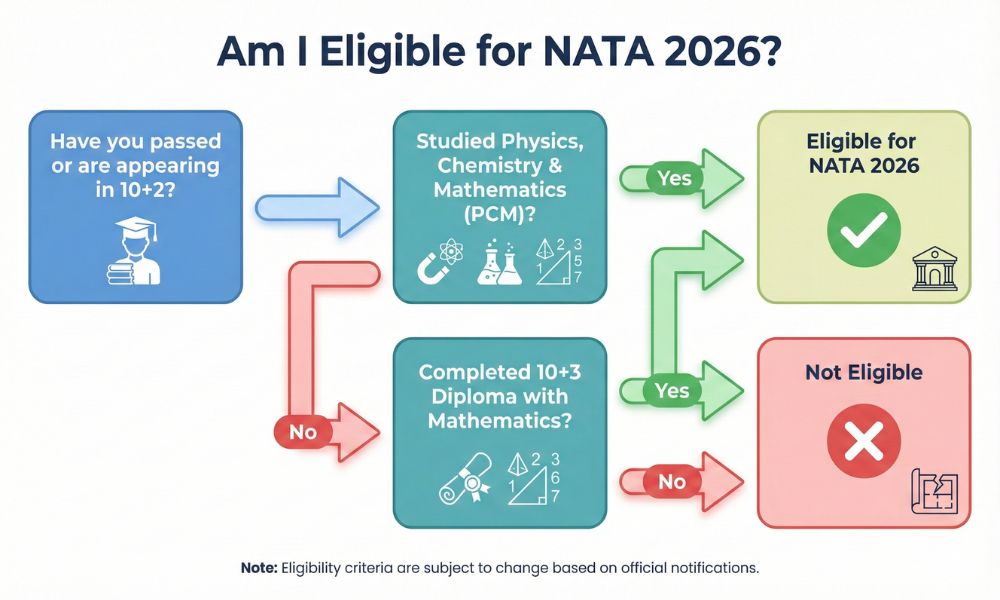
This is the most critical section. Many students prepare hard but get disqualified because they don't meet the basic criteria. The COA is very strict about the "Physics, Chemistry, and Mathematics" (PCM) rule.
4.1 Educational Qualification
Candidates must fulfill either of the following criteria:
- Option A (10+2): Passed 10+2 scheme of examination with Physics, Chemistry, and Mathematics.
Condition: You need at least 50% marks in Physics, Chemistry, and Mathematics (individually or aggregate depending on the year's specific rule, usually aggregate of PCM) AND at least 50% marks in the overall aggregate of the 10+2 exam. - Option B (Diploma): Passed 10+3 Diploma Examination with Mathematics as a compulsory subject with at least 50% marks in aggregate.
4.2 The "Appearing" Candidates
If you are appearing for your 12th Board exams or 10+3 Diploma exams in 2026, you are eligible to appear for NATA. However, your admission will only be confirmed if you pass the board exams with the required percentage before the counselling process ends.
4.3 Age Limit
COA does not impose a lower or upper age limit for NATA. However, individual states or colleges might have age criteria for admission (e.g., minimum 17 years). Always check the specific college website.
5. Step-by-Step Registration Process
The application process is fully online. Here is a foolproof guide to registering without errors.
- Sign Up: Visit www.nata.in. Click on "New Registration". You will need a valid email ID and mobile number (keep these active until admission is over).
- Profile Creation: Enter your personal details exactly as they appear on your Class 10th Marksheet. A spelling mistake here can cause issues during document verification.
- Academic Details: Enter your Class 10 and Class 12/Diploma details. If you are "Appearing", select that option.
- Document Upload: This is where most errors happen.
- Photograph: Recent color photo, JPG format, typically 4KB to 100KB.
- Signature: Scanned signature on white paper with black/blue ink.
- ID Proof: Aadhar Card/Passport/Voter ID.
- Exam Centre Selection: You will be asked to choose 3 cities in order of preference. The COA usually allocates the first preference, so choose your home city first.
- Fee Payment: Pay online via Net Banking, Credit Card, or UPI.
- Confirmation Page: Once paid, a confirmation page is generated. Save this PDF. Do not just take a screenshot.
6. Application Fees
The fee structure incentivizes taking multiple attempts. (Note: These fees are estimated based on 2025 trends and subject to change).
| Category | 1 Test | 2 Tests | 3 Tests (Best Value) |
|---|---|---|---|
| General / OBC (NCL) | ₹ 2,000 | ₹ 4,000 | ₹ 5,400 (Discounted) |
| SC / ST / EWS / PwD | ₹ 1,500 | ₹ 3,000 | ₹ 4,050 |
| Transgender | ₹ 1,000 | ₹ 2,000 | ₹ 2,700 |
| Outside India | ₹ 10,000 | ₹ 20,000 | ₹ 27,000 |
7. Exam Pattern Evolution & What to Expect
The NATA exam pattern has been dynamic. For several years, it was purely online (Aptitude). However, the COA recently reintroduced the Offline Drawing Test to truly test artistic skills. For 2026, you must prepare for a Hybrid Mode.
Part A: Drawing and Visual Composition (Offline)
- Duration: 90 Minutes.
- Task: Usually 2-3 questions requiring you to draw on an A4 sheet.
- Focus: Perspective drawing, light and shadow, memory sketching, and scale proportions.
Part B: Computer-Based Test (Online)
- Duration: 90 Minutes.
- Question Types:
- MCQ (Multiple Choice): Standard 4 options.
- MSQ (Multiple Select): More than one correct answer. No partial marking usually.
- PCQ (Preferential Choice): Answers are weighted (e.g., best answer gets 4 marks, second best gets 3).
- NAQ (Numerical Answer): You type in the number (Maths/Physics).
Confused by the Exam Pattern?
The best way to understand the pattern is to solve previous years' papers. We have a repository of past papers ready for you.
Download NATA Past Question Papers8. Detailed Syllabus Breakdown
Don't just read the headings; understand the sub-topics.
8.1 Drawing & Visual Composition (The Artist's Domain)
This section carries significant weightage. You need to master:
- Perspective:
- 1-Point: Drawing a room interior looking straight at a wall.
- 2-Point: Drawing a building from a corner view (street view).
- 3-Point: Bird's eye view (looking down from a skyscraper) or Ant's eye view (looking up).
- Light & Shadow: Understanding where the sun is and how shadows fall on cylinders, cubes, and spheres.
- Memory Drawing: "Draw a vegetable market scene" or "Draw a bus stop queue". This tests your observation of daily life.
- Color Theory: Warm vs. Cool colors, Analogous colors, and the psychological impact of color.
8.2 Cognitive Skills (The Thinker's Domain)
This is strictly online aptitude.
- Visual Reasoning: Identifying the odd shape out, completing a pattern series.
- 3D Visualization: "If I fold this paper with these cuts, what will it look like?" or "Count the number of surfaces in this complex 3D block".
- Plan & Elevation: Matching the top view of a building to its front view.
8.3 General Aptitude & Architectural Awareness
You must know the history and vocabulary of your future profession.
- Famous Architects: Works of Le Corbusier (Chandigarh), Zaha Hadid, Frank Lloyd Wright, BV Doshi, Charles Correa.
- Famous Buildings: Identifying Lotus Temple, Eiffel Tower, Burj Khalifa, Ancient Temples (Khajuraho, Konark).
- Materials: Textures of brick, stone, wood, glass, and concrete.
8.4 Mathematics & Physics (The Engineer's Domain)
NATA math is not as hard as JEE Advanced, but it requires speed.
- Maths: Matrices, Logarithms, Coordinate Geometry, Trigonometry, Probability, Statistics, and Mensuration (Area/Volume).
- Physics: Basic concepts of Optics (Light), Mechanics (Levers/Pulleys), and Electricity.
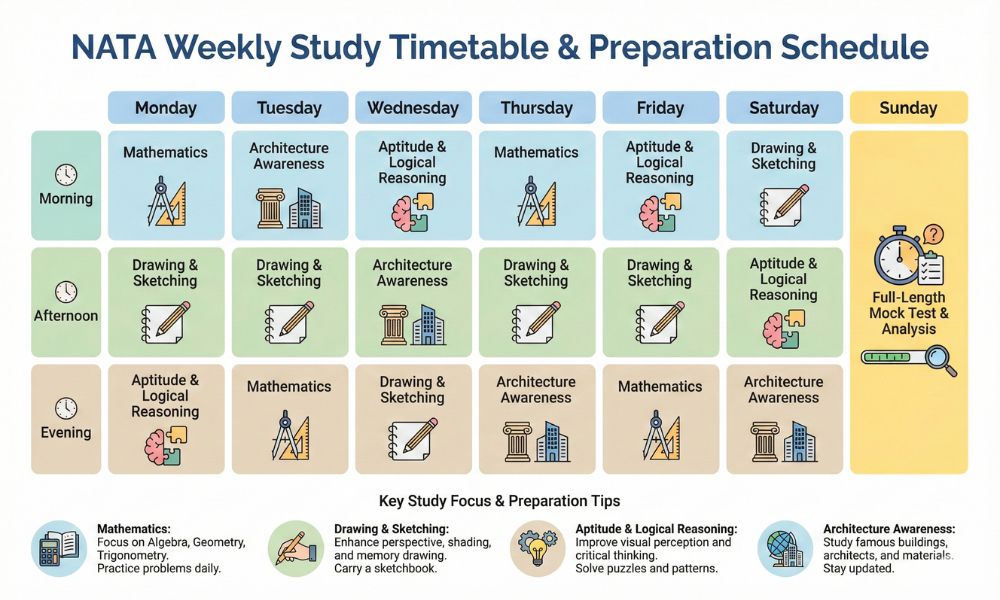
9. Master Preparation Strategy
How do you eat an elephant? One bite at a time. Here is a timeline-based strategy.
Phase 1: Foundation (6 Months Before)
- Sketch Daily: Buy a sketchbook. Draw one object daily (a bottle, a shoe, a chair). Focus on proportions.
- Maths Refresh: Ensure your Class 11 and 12 basics in Geometry and Trignometry are solid.
- Observation: When you walk on the street, look up. Notice cornices, arches, and windows.
Phase 2: Acceleration (3 Months Before)
- Perspective Training: Dedicate 1 hour daily to 1-point and 2-point perspective drawings. Use a scale initially, then move to freehand.
- GK: Start reading about Pritzker Prize winners and famous Indian monuments.
- Coaching: If you are struggling, this is the time to join a crash course. Check NATA Coaching Options.
Phase 3: Simulation (1 Month Before)
- Mock Tests: Take one test every alternate day. Sit for 3 hours straight to build stamina.
- Speed Sketching: In the exam, you have limited time. Practice completing a sketch in 20-30 minutes.
- Review: Analyze your weak areas. Are you losing marks in Math? Or is your drawing perspective off?
10. Study Resources & Best Books
Don't clutter your desk with too many books. Stick to these bibles of Architecture entrance:
- "A Complete Self Study Guide for B.Arch" by P.K. Mishra (Arihant): Excellent for theory and past questions.
- "Steps to Architecture" by Nimish Madan: Great for architectural awareness and aptitude.
- "NATA & B.Arch Question Bank" by Ar. Shadan Usmani: A must-have for practice questions.
- "Verbal & Non-Verbal Reasoning" by R.S. Aggarwal: The gold standard for the aptitude section.
- Online Resources: Use Pinterest for sketching ideas and YouTube for perspective drawing tutorials.
11. Mock Tests: The Secret Weapon
Why are mock tests crucial? Because NATA is a pressure cooker. You need to switch between creative drawing (Right Brain) and logical math (Left Brain) instantly.
- Time Management: You might get stuck shading a drawing and lose time for Aptitude. Mocks teach you to move on.
- Hybrid Experience: Since the exam might be partly online and partly offline, simulating this environment at home is vital.
- Analysis: After a mock, if you scored 120/200, find out where the 80 marks went. Was it a silly math mistake? Or did you misunderstand the drawing prompt?
12. Admit Card & Exam Day Guidelines
Downloading the Admit Card
The COA releases the admit card about 7-10 days before the exam. Check details like Name, Roll No., and Center Address carefully. If there is a discrepancy, email the NATA helpdesk immediately.
Exam Day Checklist
- Documents: Printed Admit Card + Original Photo ID (Aadhar/Passport).
- Stationery (Crucial): For the drawing test, carry your own Pencils (HB, 2B, 4B, 6B), Erasers, Sharpeners, and Dry Colors/Crayons (if allowed—check brochure).
- Dress Code: Wear comfortable clothes. Avoid heavy jewelry or metallic items to speed up security checks.
- Mental State: Arrive 60 minutes early. Panic is the enemy of creativity.
13. Results, Scorecards & Validity
NATA results are usually declared within two weeks.
- The Scorecard: It shows your marks in Part A, Part B, and Total.
- Qualifying Marks: You must score the minimum qualifying marks (usually 70-75 out of 200) to pass. However, passing isn't enough for admission.
- Validity: The score is valid ONLY for that academic year (2026-27). You cannot use a 2026 score for 2027 admissions.
14. Understanding Cut-Offs and Merit Rank
This is where things get technical. NATA itself does not give you a Rank. It gives you a Score.
The Merit Formula
Admissions in most states (like Maharashtra, Gujarat, Karnataka) are based on a 50:50 Weightage System.
Example:
NATA Score: 140/200 -> Divided by 2 = 70
Board Score: 90% -> Taken as 90
Total Merit Score = 70 + 90 = 160
This 160 is used for ranking. This is why your Class 12th Marks are just as important as NATA!
15. The Admission & Counselling Procedure
There is no single "Central NATA Counselling". You have to apply separately.
- State Counselling: Apply to state bodies like DTE Maharashtra, ACPC Gujarat, or COMEDK Karnataka. They conduct centralized rounds for all colleges in their state.
- Institutional Counselling: Universities like CEPT, Ahmedabad, or private universities often have their own application forms on their websites.
- Documents Required: NATA Scorecard, 10th & 12th Marksheets, School Leaving Certificate, Domicile Certificate (for state quotas), and Category Certificates.
16. Top Architecture Colleges & Coaching Analysis
Tier 1 Colleges (Accepting NATA)
Note: SPA (Delhi, Vijayawada, Bhopal) and NITs accept JEE Main Paper 2 scores, not NATA. For NATA, aim for:
- CEPT University, Ahmedabad: The Harvard of Indian Architecture. Very high cutoff.
- Sir JJ College of Architecture, Mumbai: Historic, prestigious, and affordable. Requires high NATA + high Board marks.
- Chandigarh College of Architecture (CCA): Excellent campus and heritage.
- Jadavpur University, Kolkata: Great ROI (low fees, good placements).
NATA vs JEE Paper 2
Ideally, you should give BOTH.
NATA: For pure architecture colleges and state govt colleges.
JEE Paper 2: Specifically for NITs, IIEST, and SPAs.
Check out the Top JEE Coaching in Delhi if you are targeting SPAs/NITs.
17. Career Scope: Beyond Buildings
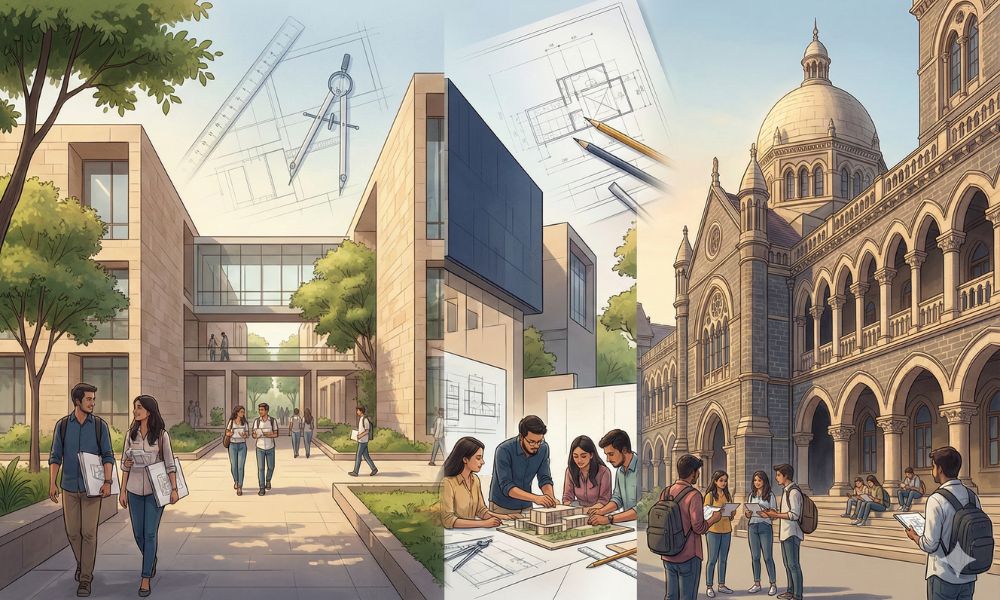
Many students think B.Arch means just designing houses. The reality is far broader.
- Urban Design: Planning cities, transport systems, and public spaces.
- Landscape Architecture: Designing parks, gardens, and sustainable outdoor environments.
- Interior Design: Focusing on furniture, lighting, and internal aesthetics.
- Conservation Architect: Restoring heritage buildings (like Taj Mahal or old forts).
- Set Design: Designing movie sets for Bollywood/Hollywood.
- Architectural Journalism: Writing about design for magazines like Architectural Digest.
18. Common Mistakes to Avoid
- Ignoring Boards: As explained in the Merit Formula, ignoring Class 12 boards is fatal. A 150 in NATA won't help if you have 55% in Boards.
- Drawing without Scale: In the exam, your "Human Figure" cannot be taller than a "Bus". Proportions matter more than beauty.
- Over-rendering: Don't spend 30 minutes shading one tree. Sketch fast, detail later.
- Not Reading the Question: If the question asks for a "Ant's Eye View" and you draw a "Bird's Eye View", you get Zero, no matter how beautiful the drawing is.
20. Conclusion: Your Journey Begins Here
The path to becoming an architect is rigorous, but it begins with a single step: The NATA Exam 2026. This exam tests not just your knowledge, but your passion, your vision, and your ability to see the world differently.
Remember, the syllabus is vast, but manageable with a strategy. Balance your board exams with aptitude practice. Sketch every day. Observe the buildings around you. And most importantly, believe in your creativity.
For regular updates on exam notifications, coaching reviews, and study material, keep visiting Top Coaching in Delhi. We are here to guide you from your first sketch to your final admission.

Other Articles

Top 10 UGC-NET Coaching in Delhi
NIFT Entrance Exam 2026