CUET Syllabus 2027: UG & PG, Eligibility, Exam Pattern
CUET

CUET Syllabus: Complete UG and PG Guide

By Team TCDOctober 16, 20267 min read

The Common University Entrance Test (CUET)is an important entrance examination for students seeking admission to undergraduate and postgraduate programmes at participating universities across India. Conducted by the National Testing Agency (NTA), CUET provides a common platform for candidates to pursue their preferred courses and academic goals.

Students aspiring to appear for CUET 2027 should understand the syllabus, eligibility requirements, examination pattern, application process and admission procedure in advance. A structured plan for studying, revision and practice can help candidates prepare more effectively.

Quick answer: The CUET syllabus depends on whether you are applying for UG or PG admission, the subjects or question paper codes you select, and the requirements of your target university. Always check the latest official NTA information and the admission criteria of each university before finalising your preparation plan.

1. Understanding the CUET Exam

CUET is conducted for undergraduate (CUET UG) and postgraduate (CUET PG) admissions. CUET UG is for students applying to undergraduate degree programmes, while CUET PG is intended for candidates seeking admission to postgraduate programmes.

The test evaluates candidates according to the subjects and paper combinations required by participating universities. Requirements may vary by course and institution, so review the latest official notification and your preferred university's admission rules before beginning preparation.

Students can explore available institutes through the CUET coaching directory on Top Coaching in Delhi and compare options based on their preparation needs.

2. CUET Syllabus

Understanding the syllabus is one of the first steps in building a preparation plan. The subjects and topics you need to study depend on the examination level, selected papers and intended course.

CUET UG Syllabus

The CUET UG syllabus may cover the following areas, depending on the subjects selected by the applicant:

  • Languages: Reading comprehension, vocabulary, grammar and verbal ability.
  • Domain subjects: Topics from subjects such as Physics, Chemistry, Mathematics, Business Studies, History, Political Science, Economics, Accountancy and Biology, according to the relevant syllabus.
  • General Test or aptitude areas, where applicable: General knowledge, current affairs, reasoning, numerical ability and quantitative aptitude.

Not every section is compulsory for every candidate. The papers and subject combinations to be selected depend on the course and university admission requirements.

CUET PG Syllabus

The CUET PG syllabus is primarily based on the postgraduate programme and question paper code selected by the candidate. It may cover subject knowledge and relevant undergraduate-level concepts.

For example, candidates applying to postgraduate programmes in Commerce, Economics, English, History, Political Science or Computer Science should focus on the syllabus and question paper code relevant to their intended programme.

Important: Check the official CUET UG or CUET PG syllabus and information bulletin when released or updated for 2027. Do not rely solely on previous years' paper combinations or syllabus summaries.

3. CUET Eligibility Criteria

Eligibility requirements differ according to the exam level, programme and university. Meeting the general examination eligibility criteria does not automatically guarantee admission to a particular course.

CUET UG Eligibility

Students who have passed Class 12 or an equivalent examination, as well as eligible candidates appearing in their qualifying examination, may apply subject to the applicable rules. Universities may specify minimum marks, required subjects, subject combinations or additional conditions for admission.

CUET PG Eligibility

Applicants generally need a relevant bachelor's degree or an equivalent qualification. Candidates appearing in the qualifying examination may also be eligible where the applicable rules permit it. Degree requirements, minimum marks and subject prerequisites vary by programme and university.

Before applying, review the eligibility conditions published by both the examination authority and the university offering your preferred course.

4. CUET Application Process

Candidates should apply through the official NTA portal specified for the relevant CUET examination. The general application process usually includes these steps:

  1. Visit the official CUET website announced by NTA.
  2. Register with the required personal details and contact information.
  3. Complete the online application form carefully.
  4. Select the appropriate subjects or question papers based on the intended course and university requirements.
  5. Upload the photograph, signature and other documents in the prescribed format.
  6. Pay the applicable examination fee through the available online payment options.
  7. Submit the application and save the confirmation page for future reference.

Review all details before submission. Keep track of the official application deadline, correction window, document specifications and any instructions mentioned in the 2027 notification.

5. CUET Exam Pattern

The CUET UG and CUET PG examination patterns may differ. The number of questions, duration, subject choices, marking scheme and negative-marking rules can be revised by NTA, so candidates should consult the latest information bulletin rather than assume that a previous year's pattern will remain unchanged.

Once the official pattern is available, note the number of questions, exam duration, marking scheme and paper options relevant to your course. Practising under timed conditions can help improve accuracy, speed and time management.

Regular online mock tests can also help candidates become familiar with the computer-based examination format. Review each test afterwards to identify weak topics and repeated mistakes.
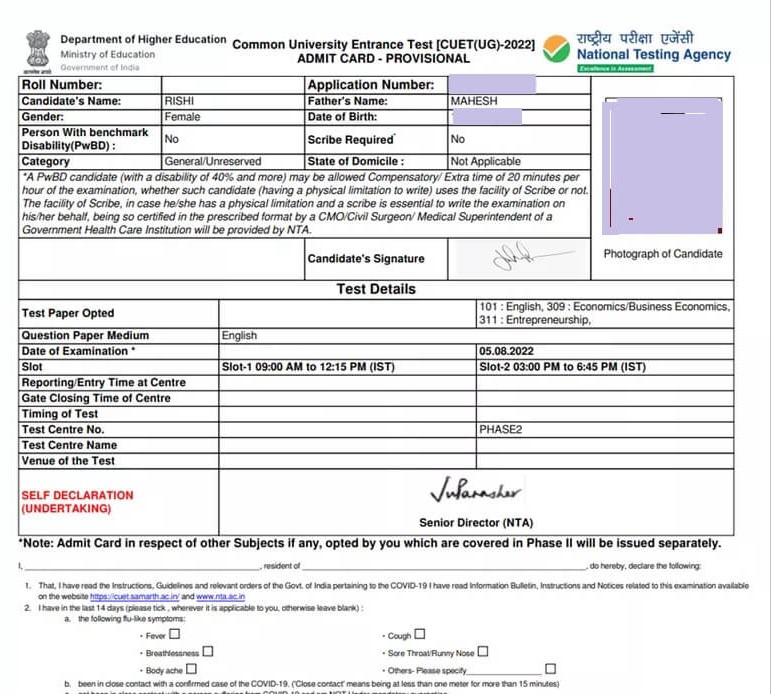
6. CUET Admit Card

The CUET admit card is an important document required to enter the examination centre. Candidates should download it from the official examination portal when it becomes available.

After downloading the admit card, check your name, roll number or application number, examination date, shift, centre address and reporting time. Follow the instructions about permitted items and identity documents carefully.

The examination city intimation slip and the admit card are different documents. Candidates should read the official notice to understand the purpose of each and should not treat the city slip as a substitute for the admit card.

7. CUET Answer Key and Result

CUET Answer Key

After the examination, NTA typically publishes a provisional answer key and explains how candidates can challenge answers within the specified period. Candidates can compare their responses with the provisional key and follow the official procedure if they wish to submit a challenge.

A final answer key may be issued after the challenge process, where applicable. Check the official notice for the challenge fee, submission deadline and required procedure.

CUET Result

CUET results or scorecards are made available through the official examination portal. Use the required login details to access and download your scorecard.

After results are declared, monitor the admission notices of your preferred universities. The next steps may include separate registration, counselling, merit-list checks, document verification, uploads and payment of admission fees.

8. How to Prepare for CUET PG

CUET PG preparation should be based on the selected subject, regular revision and consistent performance checks. The following steps can help you organise your study plan:

  1. Analyse the syllabus. Download the syllabus for your chosen question paper and divide it into manageable topics.
  2. Strengthen core concepts. Revise relevant undergraduate fundamentals and practise concepts that commonly appear in subject-based questions.
  3. Create a practical timetable. Allocate time according to topic difficulty, syllabus coverage and the time remaining before the examination.
  4. Practise previous-year questions. Use previous papers and topic-wise questions to understand question styles and identify areas that need more attention.
  5. Take timed mock tests. Attempt full-length tests under exam-like conditions and analyse mistakes, conceptual gaps and time-management issues afterwards.
  6. Prepare concise revision notes. Keep important formulas, definitions and concepts organised for quick revision.
  7. Track your progress. Review weekly mock scores, accuracy and weak topics, then adjust the next week's study plan.

Students looking for guidance can compare institutes and preparation options in the CUET coaching directory. You can also read the guide to top 10 CUET coaching in Delhi to begin comparing available options.

9. Final Preparation Tips for CUET

Start by understanding the syllabus and selecting the correct subject combination for your intended course. Build a realistic schedule that balances learning, revision and practice, and avoid spending too much time on resources that do not match the official syllabus.

Keep checking official NTA notices for the syllabus, eligibility rules, application dates, examination pattern, admit card, answer key and results. Consistent practice and careful attention to university-specific admission requirements can help you prepare in a more organised way.

For coaching options, use the CUET institute directory to compare institutes and the support they offer before making a decision.

Frequently Asked Questions (FAQs)

What is the CUET syllabus?

CUET Syllabus: Language, domain-specific subjects and areas related to aptitude (if any) for CUET UG. CUET PG syllabus: It will be as per the CUET PG question paper and pattern chosen by the candidate.

Who is eligible for CUET?

The requirements to satisfy depend on the exam and the course. UG candidates typically will have to fulfill the applicable Class 12 eligibility criteria, while PG applicants will usually have to have a suitable degree or applicable appearing state. Additional conditions can be used by universities.

How do I register for the CUET exam?

Candidates should do NTA apply online registration, fill the form, choose subject, upload images, submit application fee, keep the filled application form /confirmation page for future use.

How do I prepare for CUET PG?

Begin with the official syllabus, reinforce basics of the topic, practice previous year’s questions, take mock tests in a time-bound manner, look for trends and fallacies in your wrong attempts and study regularly.

Where can I find CUET coaching in Delhi?

Students can see which institutes are offering the courses and compare them by their course fees, location, and other preparation support by Top Coaching in Delhi.

Coaching For -
Locations -

Top Coaching in Delhi (TCD) is a trusted platform that helps students find the top coaching institutes in Delhi for UPSC, SSC, NEET, JEE, CUET, UGC-NET, CLAT, NATA, Judiciary and more.

© 2026, All Rights Reserved.

Follow Us

🏆 Fill this form now to Get Admission in Delhi’s Top Coaching Institutes with up to 70% off on fees

✅ Trusted by 10,000+ Students Across India 🔥 Fastest way to reserve your seat & save on admission fees

🏆 Fill this form now to Get Admission in Delhi’s Top Coaching Institutes with up to 70% off on fees

✅ Trusted by 10,000+ Students Across India 🔥 Fastest way to reserve your seat & save on admission fees