NIFT Entrance Exam 2026
The Comprehensive Guide to Cracking India's Premier Fashion Entrance
- 1. Introduction to NIFT 2026
- 2. About NIFT
- 3. Courses Offered
- 4. Eligibility Criteria
- 5. Important Dates (Tentative)
- 6. Application Process
- 7. Exam Pattern (CAT & GAT)
- 8. Detailed Syllabus
- 9. The Situation Test
- 10. GD & Personal Interview
- 11. Marking Scheme & Weightage
- 12. Admit Card
- 13. Result & Merit List
- 14. Counselling Process
- 15. Campuses & Seat Matrix
- 16. Preparation Strategy
- 17. Best Books & Material
- 18. Common Mistakes
- 19. Career Opportunities
- 20. Why Choose NIFT?
- 21. FAQs
- 22. Conclusion
1. Introduction to NIFT 2026
Fashion is not just about clothing; it is a blend of art, culture, technology, and business. For aspirants looking to make a mark in the global fashion industry, the National Institute of Fashion Technology (NIFT) is the ultimate destination. As we approach the academic cycle for 2026, the buzz around the NIFT Entrance Exam is already building up.
The NIFT Entrance Exam 2026 is a national-level examination conducted to shortlist candidates for admission into premier Undergraduate (Bachelor of Design, Bachelor of Fashion Technology) and Postgraduate (Master of Design, Master of Fashion Management, and Master of Fashion Technology) programs across the country. It is widely regarded as one of the most competitive design entrance exams in India.
If you have a creative flair, an eye for detail, or a strategic mind for fashion business, NIFT 2026 is your gateway to a thriving career. This guide will walk you through every single aspect of the exam - from the application form to the final counseling round.
2. About NIFT (National Institute of Fashion Technology)
Established in 1986 under the aegis of the Ministry of Textiles, Government of India, NIFT was set up as a center of excellence in fashion education. Over the last three decades, it has evolved into a pioneer institute, not just in India but globally.
In 2006, the NIFT Act granted the institute statutory status, empowering it to award degrees. NIFT plays a pivotal role in providing the textile and apparel industry with highly skilled professionals. Whether it is haute couture, fast fashion, textile innovation, or fashion marketing, NIFT graduates are at the helm of industry leadership.
With its curriculum benchmarked against the best in the world (like FIT New York and London College of Fashion), NIFT provides a perfect blend of traditional Indian craftsmanship and modern technology. You can visit the official NIFT website for more institutional details.
3. Courses Offered Through NIFT 2026
NIFT offers a diverse range of programs catering to different interests, from pure design to technology and management. Many top coaching centers specialize in preparing students specifically for these streams.
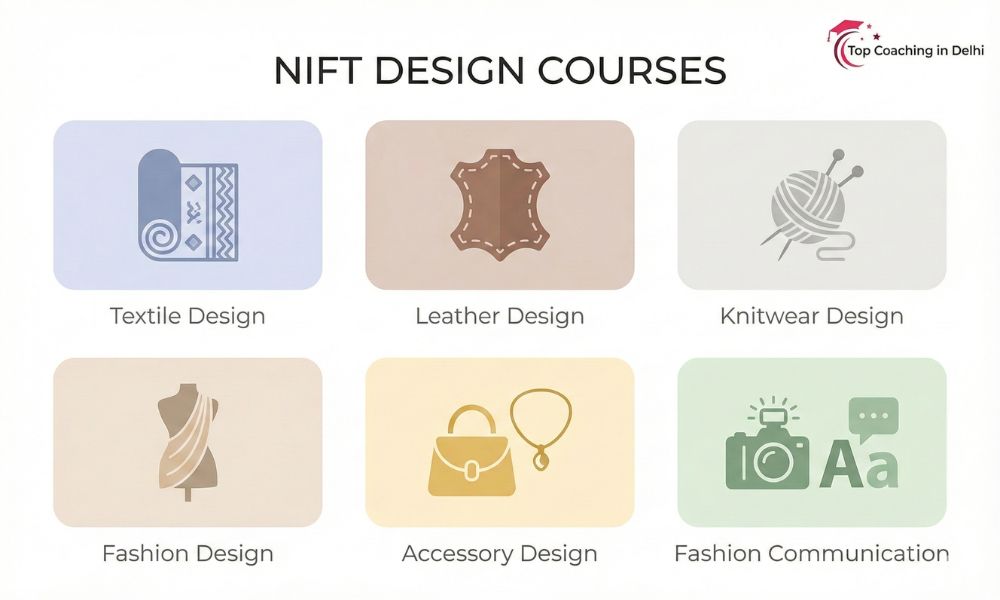
Undergraduate (UG) Programs
Bachelor of Design (B.Des) - 4 Years
This is the most popular course for creative students. It includes:
- Fashion Design (FD): Focuses on apparel creation, trends, and fashion history.
- Communication Design (FC): Covers graphic design, photography, visual merchandising, and branding.
- Textile Design (TD): Deals with surface ornamentation, prints, weaving, and knitting technologies.
- Knitwear Design (KD): specialized course for the woolen and knitwear industry.
- Leather Design (LD): Focuses on footwear, bags, and luxury leather goods.
- Accessory Design (AD): Covers jewelry, home decor, and lifestyle accessories.
Bachelor of Fashion Technology (B.FTech) - 4 Years
Apparel Production: A techno-managerial course for students with a Physics, Chemistry, and Math (PCM) background. It focuses on garment manufacturing, quality control, and supply chain.
Postgraduate (PG) Programs
- Master of Design (M.Des): An interdisciplinary course for advanced research and design.
- Master of Fashion Management (MFM): Focuses on fashion marketing, retail, and merchandising.
- Master of Fashion Technology (M.FTech): Advanced course for B.FTech or Engineering graduates.
4. NIFT 2026 Eligibility Criteria
Before beginning your preparation, it is crucial to ensure you meet the eligibility requirements.
For Bachelor of Design (B.Des)
- Qualification: Passed the +2 level examination in the 10+2 pattern of examination of any recognized Central/State Board of Secondary Examination (CBSE, ICSE, or State Board).
- Stream: Students from any stream (Science, Commerce, Arts/Humanities) are eligible.
- Age Limit: The maximum age allowed is generally 24 years as of August 1st of the year of admission (relaxation applies for SC/ST/PWD).
For Bachelor of Fashion Technology (B.FTech)
- Qualification: Passed the +2 level examination in the 10+2 pattern of examination.
- Mandatory Subjects: Physics, Chemistry, and Mathematics (PCM).
For PG Courses (M.Des, MFM, M.FTech)
- Age Limit: No age limit for PG courses.
- Qualification: An undergraduate degree from a recognized university. For M.FTech, a B.FTech or B.E/B.Tech degree is usually required.
5. NIFT 2026 Important Dates (Tentative)
NIFT strictly follows its academic calendar. Based on previous trends, here is the tentative schedule for 2026.
| Event | Tentative Timeline |
|---|---|
| Notification Release | November 2025 |
| Online Application Starts | December 2025 (First Week) |
| Last Date to Apply | January 2026 (First Week) |
| Admit Card Release | January 2026 (Third Week) |
| Entrance Exam Date | February 2026 (First Sunday) |
| Result Declaration (Written) | March 2026 |
| Situation Test / GD / PI | April 2026 |
| Final Result Declaration | May 2026 |
6. NIFT 2026 Application Process
The application process is entirely online. Follow these steps to register:
- Registration: Visit the official NIFT admissions portal. Create a login using your valid email ID and phone number.
- Fill Details: Complete the application form with personal details, educational qualifications, and program preference.
- Upload Documents: Upload scanned copies of your photograph, signature, and caste certificate (if applicable) as per the specified resolution.
- Payment: Pay the application fee.
- General/OBC/EWS: Approx. ₹3000
- SC/ST/PWD: Approx. ₹1500
- Confirmation: Download the confirmation page for future reference.
Note: Always keep an eye out for the "Correction Window" which usually opens for 2-3 days after the registration closes, allowing you to fix minor errors.
7. NIFT Entrance Exam 2026 - Exam Pattern
The NIFT exam is unique because it tests both your left brain (logic/math) and right brain (creativity). To understand the difficulty level, it is highly recommended to check previous year question papers.
1. Creative Ability Test (CAT)
For B.Des & M.Des only. This is a pen-and-paper drawing test. It is designed to judge intuition, skill, power of observation, innovation in the development of a concept, and design ability.
- Duration: 3 Hours
- Focus: Sketching, coloring, 3D visualization, and visual communication.
2. General Ability Test (GAT)
For All Courses. This is an objective-type test. Practicing Online MCQs can significantly improve your speed in this section.
- Quantitative Ability: Addition, Multiplication, Division, Fractions, Percentage, Rate of Interest, Work and Task, Ratio and Proportion, and Distance.
- Communication Ability: Synonyms, Antonyms, Words with corresponding meanings, Singular, Plural, One-word substitutes, Idioms and phrases.
- English Comprehension: Reading passages and answering questions based on them.
- Analytical Ability & Logical Reasoning: Inferences, series, coding-decoding.
- General Knowledge: Current affairs, fashion industry news, history, and geography.
8. NIFT 2026 Syllabus (Detailed)
To crack NIFT, you need a targeted approach towards the syllabus.
CAT Syllabus (Creative Ability Test)
- Design Theory: Elements and principles of design.
- Perspective Drawing: 1-point, 2-point, and 3-point perspective (Bird's eye/Worm's eye view).
- Human Anatomy: Sketching human figures in various postures.
- Memory Drawing: Drawing scenes from daily life (e.g., a busy railway station, a festival).
- Visual Communication: Designing posters, stamps, mascots, and logos.
- Color Theory: Psychology of colors, color mixing, and schemes.
- Product Design: Reimagining everyday objects creatively.
GAT Syllabus (General Ability Test)
- Math (Class 10 level): Profit & Loss, Time & Work, Speed & Distance, Averages, Simple/Compound Interest.
- Reasoning: Syllogism, Blood Relations, Directions, Clocks & Calendars, Dice & Cubes.
- English: Vocabulary, Grammar correction, Para-jumbles, Analogies.
- GK & Current Affairs: Brand taglines, logos, famous designers, textile heritage of India, recent awards, and sports.
9. Situation Test (The Game Changer)
For B.Des candidates who clear the written exam (CAT + GAT), the Situation Test is the next hurdle. This is a "hands-on" test.

- What happens? You are given a packet of materials (cardboard, wire, clay, colored paper, straw, ice cream sticks, etc.) and asked to create a 3D model based on a theme.
- Theme Examples: "Design a waiting area for a kids' hospital," "Create a memento for a fashion show," or "Depict an emotion like anger or joy."
- Evaluation: You are judged on material manipulation, innovative use of materials, composition, and the "Write-up" explaining your concept.
10. Group Discussion & Personal Interview (PG Courses)
For Master's programs (MFM, M.Des, M.FTech), there is no Situation Test. Instead, candidates face a GD/PI round.
- Group Discussion: Topics are often related to the fashion industry, social issues, or management case studies. (e.g., "Is Fast Fashion Sustainable?", "Impact of AI on Design").
- Personal Interview: The panel assesses your career goals, why you chose NIFT, and your portfolio (if applicable).
11. NIFT 2026 Marking Scheme & Weightage
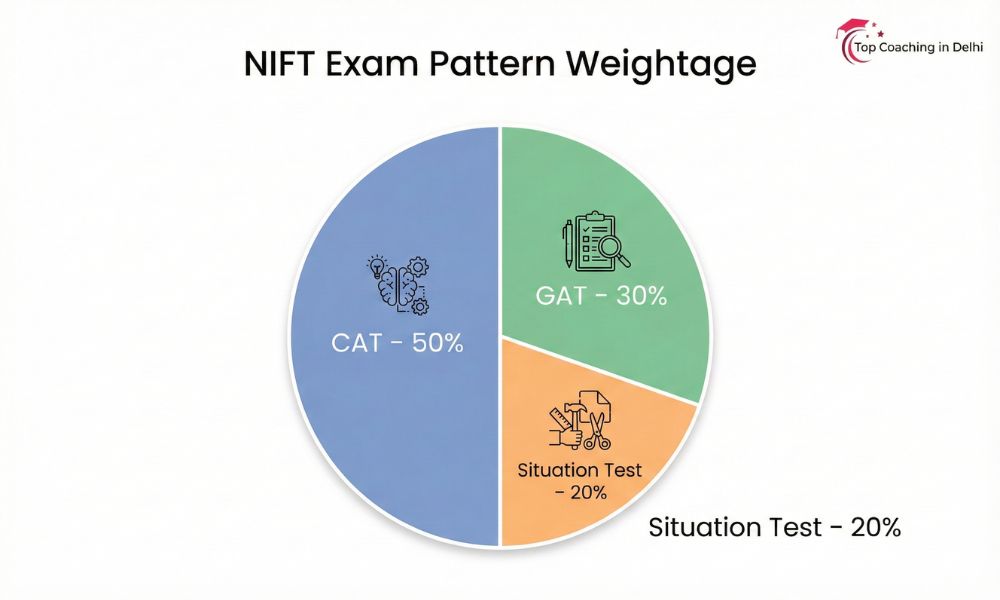
Understanding the weightage helps you prioritize your study time. The final merit list is calculated based on the following breakdown:
Bachelor of Design (B.Des)
| Test Component | Weightage |
|---|---|
| CAT (Creative Ability Test) | 50% |
| GAT (General Ability Test) | 30% |
| Situation Test | 20% |
| Total | 100% |
Master of Fashion Management (MFM)
- GAT: 70%
- GD/PI: 30%
12. NIFT 2026 Admit Card
The Admit Card is usually released two weeks before the exam on the official NIFT website. Candidates must download it using their application number and password. It contains details like:
- Exam Center Venue
- Reporting Time
- Exam Instructions
- Candidate Photograph & Signature
Mandatory Requirement: Carry a printout of the admit card along with a valid original photo ID (Aadhar Card, Voter ID, or Passport) to the exam center.
13. NIFT 2026 Result & Merit List
Results are declared in two stages for B.Des candidates. First, the written exam result qualifies you for the Situation Test. The final result is a composite score of all rounds.
The Common Merit Rank (CMR) is generated based on your category. NIFT is highly transparent, and you can see your sectional scores.
14. NIFT 2026 Counselling & Seat Allotment
Once the final merit list is out, the counselling process begins (usually in May/June). It is a centralized online process.
- Registration: Qualified candidates register for counselling.
- Choice Filling: You must rank your preferred Campuses and Courses (e.g., 1. NIFT Delhi - Fashion Design, 2. NIFT Mumbai - Fashion Communication).
- Seat Allocation: The system allocates seats based on your CMR and category.
- Document Verification: Physical verification of 10th/12th mark sheets and certificates at the nearest NIFT campus.
15. NIFT Campuses & Seat Matrix
There are currently 18+ NIFT Campuses across India. The top-tier campuses are generally considered to be:
- NIFT New Delhi
- NIFT Mumbai
- NIFT Bengaluru
- NIFT Chennai
- NIFT Gandhinagar
- NIFT Kolkata
- NIFT Hyderabad
Other prominent campuses include Patna, Bhopal, Jodhpur, Kangra, Bhubaneswar, Raebareli, Shillong, Srinagar, Panchkula, and Daman. The total seat intake across all courses is approximately 5,000+.
16. NIFT 2026 Preparation Strategy
Top Strategy for CAT
Don't just draw 'pretty' pictures. NIFT looks for ideas. If asked to draw a "Roadside Cafe," don't just draw tables. Draw the interaction between people, the stray dog waiting for food, the steam from the tea, and the chaos of the traffic. Details tell a story.
CAT Preparation:
- Daily Sketching: Dedicate 1 hour daily to sketching objects around you (shoes, bottles, hands).
- Time Management: Practice completing 3 sketches in 3 hours. Speed is critical.
- Creative Thinking: Practice transforming random shapes into meaningful objects.
GAT Preparation:
- Mathematics: Stick to NCERT 10th-grade books. Speed math is key.
- English: Read newspapers (The Hindu/Indian Express) daily to improve vocabulary and comprehension speed.
- Mock Tests: Solve at least 15-20 previous year question papers. This helps you understand the difficulty level.
If you need professional guidance, you can explore the Top 10 NIFT Coaching Centers in Delhi to boost your preparation.
17. Best Books & Study Material
While coaching material is good, standard books are essential for self-study.
- NIFT/NID/IIFT Entrance Exam Guide by R. Gupta.
- NIFT Entrance Exam Self Study Guide by Arihant Experts.
- Elementary Mathematics by R.S. Aggarwal (For GAT Math).
- High School English Grammar by Wren & Martin (For English).
- Manorama Yearbook (For General Knowledge).
18. Common Mistakes to Avoid
- Neglecting GAT: Many creative students focus only on drawing. Remember, GAT is 30% of your score. If you fail GAT, your CAT paper might not even save you.
- Using Low-Quality Colors: In CAT, use good quality pencil colors or dry pastels. Avoid watercolors if the paper quality provided is thin (it might tear).
- Ignoring Negative Marking: GAT usually has negative marking (0.25). Don't guess wildly.
- Poor Time Management: Getting stuck on one drawing in CAT can ruin the paper. Allocate time strictly per question.
19. Career Opportunities After NIFT
A degree from NIFT opens doors to prestigious roles in the industry.
- Fashion Designer: Launch your own label or work for brands like Sabyasachi, Manish Malhotra, Zara, or H&M.
- Fashion Stylist: Work in Bollywood, magazines (Vogue, Harper's Bazaar), or advertising.
- Visual Merchandiser: Design store layouts and window displays for retail giants.
- Fashion Buyer: Decide what merchandise a store will sell for the coming season.
- Textile Designer: Work with export houses or home furnishing brands (FabIndia, Ikea).
- UX/UI Designer: Many Fashion Communication grads move into digital product design.
Average Salary: Starting packages range from ₹5 LPA to ₹18 LPA depending on the portfolio and campus placements.
20. Why Choose NIFT for Fashion Education
NIFT isn't just a college; it's a brand. The "NIFT" tag on your resume signifies that you have survived rigorous training.
- Industry Exposure: Regular workshops with industry leaders and visits to textile mills/export houses.
- Craft Cluster Initiative: Students spend time in rural India working with artisans, understanding grassroots fashion.
- Alumni Network: The NIFT alumni network is powerful and spread across the globe.
- Placements: NIFT has a centralized placement process where top companies recruit students from all campuses.
21. Conclusion
The journey to NIFT 2026 will be challenging, but the reward is a lifetime career in one of the most dynamic industries in the world. The key to cracking this exam is balance - balancing your creative expression with logical reasoning, and balancing your dream with disciplined practice.
Start your preparation early. Observe the world around you, sketch what you see, and stay updated with the fashion world. Whether you dream of showcasing at Paris Fashion Week or managing a global retail chain, NIFT is where that dream begins.

Other Articles